 Liste de partage de Grorico

Des amateurs parviennent à peu de frais à envoyer des fusées miniatures jusqu'à des altitudes très estimables. L'activité porte même un nom : l'astromodélisme. Alors pourquoi ne pas ré...
Trois millions de Français en souffrent. La dépression n'est donc pas une maladie à prendre à la légère, d'autant que beaucoup de cas ne seraient pas diagnostiqués. Il s'agit souvent d'un trouble causé ou aggravé par un ensemble de facteurs (psychologiques, génétiques, sociaux et biologique...
La vingt-septième édition du Chaos Communication Congress (CCC) aura lieu du 27 au 30 décembre à Berlin. Cette année, le thème principal est : “We come in peace”. Un appel à propositions pour des conférences, lectures, et ateliers a été lancé autour d’une liste de sujets tels la neutralité du net, la vie privée, la surveillance, l’anonymat, le DPI… et le MacGyverism appliqué.
« We come in peace, said the conquerers of the New World.
We come in peace, says the government, when it comes to colonise, regulate, and militarise the new digital world.
We come in peace, say the nation-state sized companies that have set out to monetise the net and chain the users to their shiny new devices.
We come in peace, we say as hackers, geeks and nerds, when we set out towards the real world and try to change it, because it has intruded into our natural habitat, the cyberspace. »
A lire sur : 27C3: We come in peace – Call for Participation (CCC)
Via : 27C3: We come in peace (Vasistas)


Today we’re introducing Raindrop, an exploration in messaging innovation being led by the team responsible for Thunderbird, to explore new ways to use Open Web technologies to create useful, compelling messaging experiences.
We hope to lead and spur the development of extensible applications that help users easily and enjoyably manage their conversations, notifications, and messages across a variety of online services. A central principle behind Raindrop is that messaging should be personal — we want Raindrop to be people-centric both in how we process messages, and in how we can help give people control over their personal data and experiences.
When a friend’s link from YouTube or flickr arrives, your messaging client should be able to show the video or photos near or as part of the message, rather than rudely kicking you over to a separate browser tab. Notifications from computers and mailing lists should be organized for you, not clutter your Inbox or require tedious manual filter setup. It should be easy to smoothly integrate new web services into your conversation viewer entirely using open web technologies.
Raindrop 0.1: A Prototype
To this end, we’ve started Raindrop, which we hope will become both a customizable product and a platform for a variety of innovative messaging applications on the Web. We’ve also drafted a set of principles that we believe will help ensure that it is as useful, usable, and compelling as possible. Today, we’re releasing version 0.1, which is very much an iterating prototype, not yet ready for everyday use. Join us and help drive it there!
Design
What does a conversation on today’s web look like? Email used to house the bulk of the conversations that took place on the internet, but that’s no longer the case today. In today’s world people use a combination of Twitter, IM, Skype, Facebook, Google Docs, Email, etc. to communicate. For many of us this means that we have to keep an eye on an ever-growing number of places we might get new messages. As a result, we never know that we’ve actually processed all the important messages, because our email has been overwhelmed by noise which obscures the real messages from real people.
Raindrop is an effort that starts by trying to understand today’s web of conversations, and aims to design an interface that helps people get a handle on their digital world. At the same time, it creates a programming interface (API) that helps designers and developers extend our work and create new systems on top of that data. We aren’t trying to invent new protocols or build new messaging systems, rather focusing on building a product that lets users get a handle on the systems we already use.
The Raindrop team has already gone through 2 initial iterations which demonstrate the power of the platform we already have and the possibilities that lay ahead.
The following video discusses some of the fundamental ideas in today’s Raindrop.
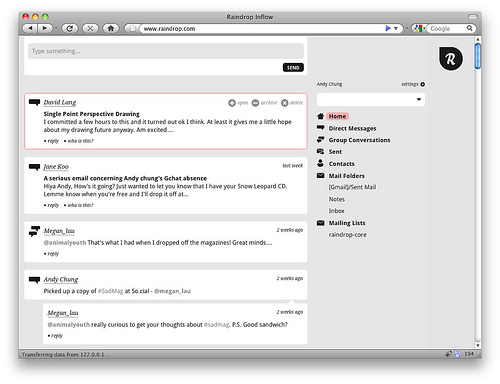
First iteration of the Raindrop user interface
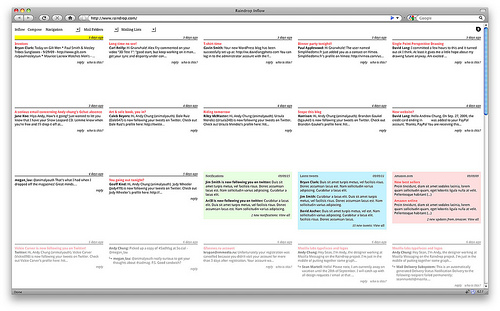
Second iteration of the Raindrop design
Development Platform
We intend to support front-end applications of various kinds (including mobile), but our flagship applications will be built entirely for any modern web browser that supports Open Web technologies. Version 0.1 of our prototype embeds Bespin to support a fast, iterative development style. It also provides front-end widgets and back-end code that supports important high-level concepts such as people, conversations, and mailing lists, with more to come. CouchDB and Python are key parts of our prototype architecture as well.
What’s Next
We’re just getting started and expect Raindrop to evolve quickly.
One of our first priorities is to make downloadable installers or setup a hosted installation that anyone can use to try things out — making it easier for non-developers to check it out.
Because Raindrop is very much iterative and design-driven, another priority is to implement a default configuration that asks (but does not require!) each user to contribute anonymized usage data back to the Mozilla design community in a way that respects your privacy.
We’re tracking other priorities in our evolving roadmap.
Get Involved
Mozilla Labs is a virtual lab where people come together online to create, experiment and play with Web innovations for the public benefit. The Raindrop exploration is still in its infancy and just getting started.
All of the source code underlying the Raindrop exploration & prototype is being released as open source software under the the MPL.
There are many ways to join the team and get involved:
- Ask questions and contribute ideas at our GetSatisfaction community.
- Upload a mock-up or design to the Raindrop Design group on Flickr.
- Pull the source code and start hacking.
- Join us in our chat room.
We’ll also be using the #raindrop hashtag on twitter. Our community page has more details about these and other ways to connect.
– Andy Chung, Bryan Clark, Dan Mosedale, David Ascher, Mark Hammond, and James Burke on behalf of the Raindrop development team
